David L. Donoho¹,
Jian Kang²,
Xihong Lin³,
Bhramar Mukherjee⁴,
Dan Nettleton⁵,
Rebecca Nugent⁶,
Abel Rodriguez⁷,
Eric P. Xing⁸,
Tian Zheng⁹,
and Hongtu Zhu¹⁰*
January 5, 2026
Artificial intelligence is no longer a future possibility—it is reshaping how knowledge is produced, validated, and deployed.
This raises a difficult question for our field:
What is the role of statistics when models scale to trillions of parameters,
data pipelines become engineering systems,
and empirical performance often outpaces theoretical understanding?
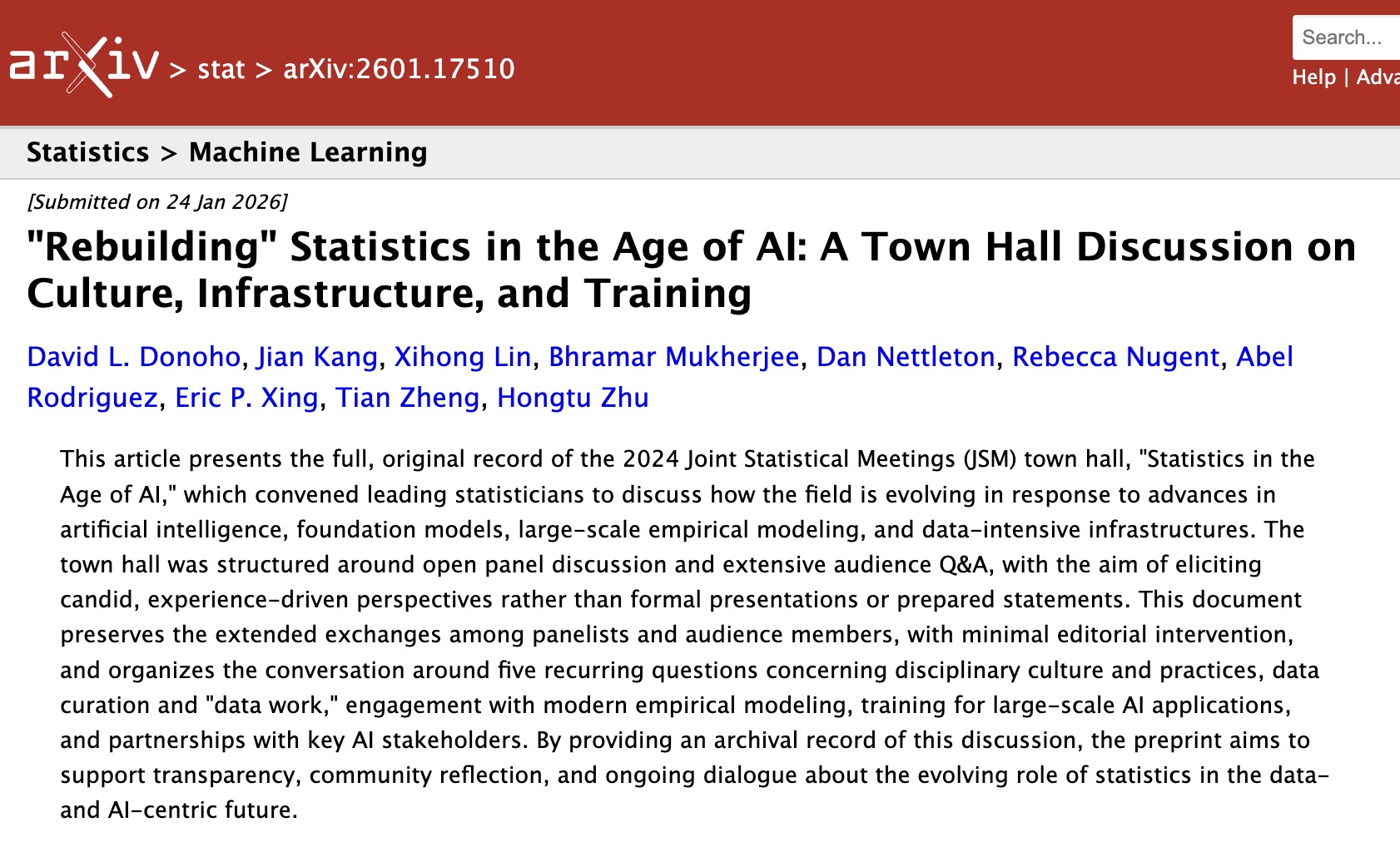
At JSM 2024, a town hall brought together leaders across statistics,
biostatistics, and machine learning—including
David L. Donoho,
Jian Kang,
Xihong Lin,
Bhramar Mukherjee,
Dan Nettleton,
Rebecca Nugent,
Abel Rodriguez,
Eric P. Xing,
Tian Zheng,
and Hongtu Zhu—for a rare, candid discussion.
Rather than formal talks or polished conclusions, the session surfaced tensions:
rigor versus utility, theory versus systems, methods versus data work,
and disciplinary identity versus real-world impact.
This article preserves the full, unfiltered record of that conversation.
It is not a manifesto—but a snapshot of a field at a crossroads.

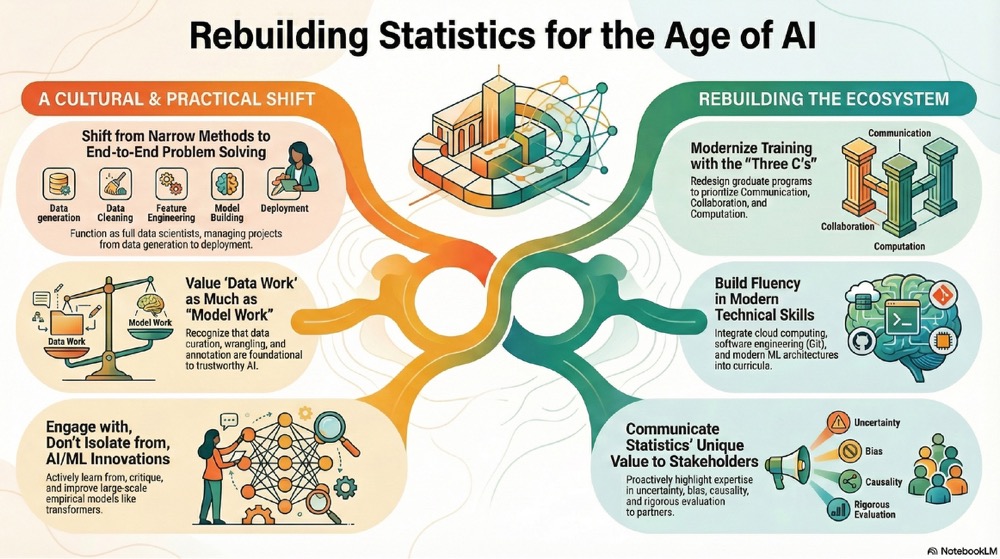
Five Strategic Shifts Statistics Can No Longer Avoid
1
Shift to End-to-End Problem Solving
Statistical impact can no longer stop at method development.
To remain relevant, statisticians must take responsibility for entire systems—from
data generation and modeling to deployment, monitoring, and failure modes.
2
Elevate the Value of "Data Work"
In modern AI systems, data work determines bias, robustness, and credibility.
Curation, annotation, and infrastructure are not auxiliary tasks—they are
first-class scientific contributions that shape what models can learn.
3
Engage with Empirical Modeling
Rather than treating large-scale models as external engineering artifacts,
statisticians must engage directly with empirical systems such as Transformers—
to analyze their behavior, expose failure modes, and improve evaluation and reliability.
4
Modernize Training with the "Three C's"
Training models designed for small data and isolated analysis is no longer sufficient.
Future statisticians must be fluent in communication, collaboration, and computation,
working in teams and operating within large, evolving technical ecosystems.
5
Articulate Unique Value to Stakeholders
Statistics must actively articulate its value to AI stakeholders.
Uncertainty quantification, causal reasoning, and bias analysis are not abstract ideals—
they are essential tools for building trustworthy, high-stakes AI systems.