BIOS 740: Deep Learning Methods in Biomedical Sciences with PyTorch

Shan Gao

2026-05-03

BIOS 740 — Deep Learning Methods in Biomedical Sciences with PyTorch | UNC
BIOS 740 · Spring 2026 UNC · Department of Biostatistics
A graduate course at UNC

Deep Learning Methods in Biomedical Sciences with PyTorch

A modern AI curriculum taught with the rigor of statistics — built around real biomedical data and the problems that actually matter: imaging, genomics, electronic health records, and beyond.
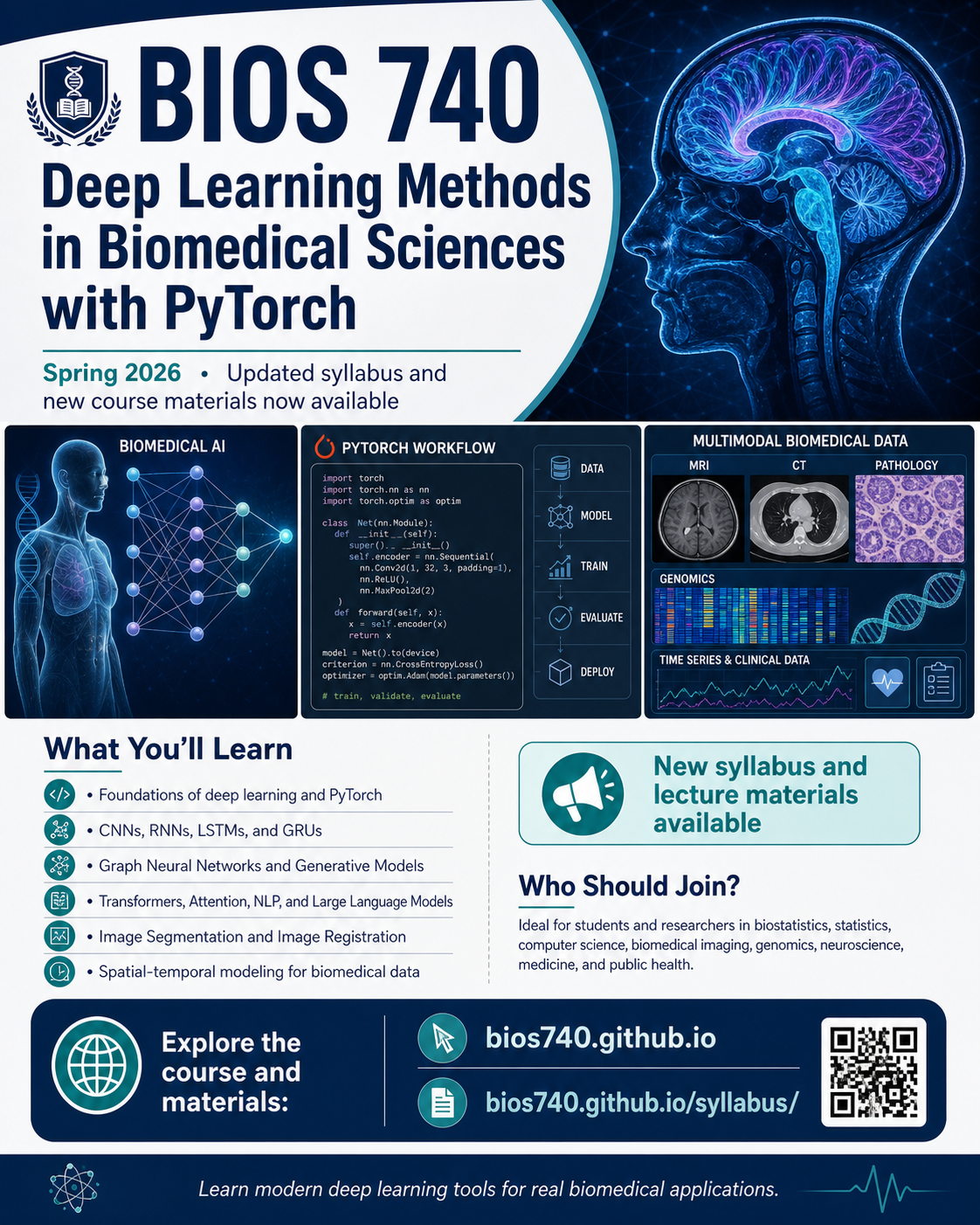
BIOS 740 — Deep Learning Methods in Biomedical Sciences with PyTorch (Spring 2026 poster)
Spring 2026
New syllabus · materials online
01The Curriculum

From foundations to the frontier.

i.
Foundations of Deep Learning & PyTorch
Tensors, autograd, optimization, training loops — the practical scaffolding behind every model.
ii.
CNNs, RNNs, LSTMs & GRUs
The classic architectures, taught well — still the bedrock of imaging and sequence modeling.
iii.
Graph Neural Networks & Generative Models
From molecular graphs to diffusion — how to model structure and how to generate it.
iv.
Transformers, Attention, NLP & LLMs
The dominant architecture of modern AI — pretraining, fine-tuning, and clinical text.
v.
Image Segmentation & Registration
Pixel-level decision-making for medical imaging — where models meet radiology.
vi.
Spatio-Temporal Modeling
Methods for biomedical data with spatial and temporal structure — fMRI, longitudinal records, and more.
— The data you'll work with

Multimodal biomedical data, at real-world scale.

01MRI
02CT
03Pathology
04Genomics
05Clinical & time series
02Why It's Different

Most courses teach tools. This one teaches judgment.

Application-driven. Real scientific problems and real datasets — not curated benchmarks built for demonstrations.

Statistics meets ML. Few courses sit at the intersection of statistics, machine learning, and biomedical data science. This one lives there.

Built for the AI era. Skills that translate directly to research labs and production teams — not just to the next assignment.

Project-shaped. You leave with work you can show — to advisors, to reviewers, to hiring committees.

03Who It's For

Built for graduate students and researchers.

Ideal for students and researchers in biostatistics, statistics, computer science, biomedical imaging, genomics, neuroscience, medicine, and public health.

04Taught By

The team behind the course.

BIOS 740 instructors
Instructors
Prof. Hongtu Zhu · with TA Runpeng Dai
Department of Biostatistics, UNC Chapel Hill
BIOS 740 · UNC Chapel Hill Department of Biostatistics